Casino Dice Games in Australia: Rules and Risks
 Available in AU

Online dice formats range from craps to screen-based games, but Australian law and the operator’s role shape what is lawful to offer.
Table of Contents
- Online Dice Games and the Australian Rules That Matter
- What Casino Dice Games Are—and What They Aren’t
- How to Follow a Dice Game Before You Play
- Different Casino Games That Use Dice
- Craps and the Dice Table
- Rules and What to Check Before Choosing a Dice Game
- A Sober Approach to Dice-Game Strategy
- What Live Dice Play Means
- Where You Roll: Dice Games at a Table or on a Screen
Online Dice Games and the Australian Rules That Matter
Searching for dice games online can make the subject sound like a simple choice of format: find a virtual table, place a wager and watch the result. In Australia, though, the first thing to understand is the legal setting. Real-money online casino games are not a lawful service for operators to provide to people in Australia, whether the game uses dice or cards, or is presented as a table game on a screen.
The law at the centre of this is the Interactive Gambling Act 2001. It bars operators from supplying real-money online casino services to people physically located in Australia. Casino-style offerings such as roulette, poker, blackjack and slots fall within the prohibited interactive gambling category; putting dice at the centre does not make an online casino service a different legal product. The restriction is on the operator providing the service. A player is not criminalised simply for using an offshore site, but that does not make the service lawful to offer here.
When choosing an online casino for dice games in Australia, it helps to check the available operator details before deciding where to play. Use these notes as a starting point and confirm the relevant terms for yourself.
1. GoldenCrown
License: Curacao Gaming Control Board OGL/2023/176/0095 (Hollycorn N.V.) GoldenCrown’s listed licensing detail is a Curacao Gaming Control Board licence, OGL/2023/176/0095, held by Hollycorn N.V. This gives you a specific credential to consider when assessing the operator.
2. Neospin
License: Curacao Gaming Control Board OGL/2023/176/0095 (Hollycorn N.V.) Neospin lists a Curacao Gaming Control Board licence, OGL/2023/176/0095, held by Hollycorn N.V. You can use that licensing detail as one point of reference when considering the operator.
3. Wild Tokyo
License: Curacao · Payout speed: crypto 30-60 minutes, fiat 1-5 days · Min. deposit: A$10 Wild Tokyo lists a Curacao licence, with withdrawals described as taking 30–60 minutes for crypto and 1–5 days for fiat. Its minimum deposit is A$10, which gives you a concrete entry amount to consider.
4. Ricky Casino
Payout speed: crypto under 1 hour, PayID 1-3 business days · Min. deposit: A$20 (A$30 to qualify for the bonus) Ricky Casino lists crypto withdrawals in under an hour and PayID withdrawals in 1–3 business days. The minimum deposit is A$20, or A$30 to qualify for the bonus.
5. DragonSlots Casino
License: Curacao Gaming Authority (Jumpman Gaming Ltd) DragonSlots Casino lists a Curacao Gaming Authority licence held by Jumpman Gaming Ltd. That licensing information is the main specific detail available for you to assess.
6. Vegaz Casino
License: Curacao OGL/2024/1335/0780 · Min. deposit: EUR 20 Vegaz Casino lists licence OGL/2024/1335/0780 and a minimum deposit of EUR 20. You can consider both details when reviewing the operator.
7. WinSpirit Casino
License: Curacao eGaming OGL/2024/923/0383 (Antillephone N.V.) · Min. deposit: A$30 WinSpirit Casino lists a Curacao eGaming licence, OGL/2024/923/0383, held by Antillephone N.V. Its stated minimum deposit is A$30.
8. House of Pokies
License: international iGaming licence – jurisdiction not named in the source · Payout speed: PayID 1-24 hours · Min. deposit: A$30 (PayID from A$10) House of Pokies lists PayID withdrawals of 1–24 hours and a minimum deposit of A$30, reduced to A$10 for PayID. The source describes its licence as international but does not name the jurisdiction.
9. Lucky Dreams
License: Curacao · Min. deposit: A$20 (POLi) Lucky Dreams lists a Curacao licence and a minimum deposit of A$20 via POLi. These details give you a basic reference when considering the operator.
10. JustCasino
License: Curacao Gaming Control Board JustCasino lists a Curacao Gaming Control Board licence. This is the specific operator detail available for you to consider.
That distinction matters when you encounter an online dice game described as available to Australians. An offshore licence is not an Australian authorisation, and accepting Australian payments does not change the position. The country where an operator is licensed and the country where a customer is located are separate parts of the picture. For Australian residents, the relevant issue is whether the service can lawfully be supplied to someone here.
Enforcement is handled federally by the Australian Communications and Media Authority (ACMA). Its role includes applying the Interactive Gambling Act and monitoring compliance with federal interactive gambling rules. Where a website provides a prohibited service, or advertises one to Australians, ACMA can ask internet service providers to block access. A page that appears one day may therefore be inaccessible later. That is not proof that the operator has become locally approved; it may simply reflect an enforcement action.
The scale of those actions gives useful context. ACMA reports that it has blocked more than 1,455 illegal gambling and affiliate websites since November 2019. That figure includes affiliate sites as well as gambling sites, so it should not be read as a count of online casinos alone. There is also a discrepancy in published totals for services leaving the market: one account puts the number above 210 since enforcement began in 2017, while another reports more than 190 over the same period. The difference is worth stating plainly rather than presenting either figure as an uncontested count.
For someone curious about a casino dice game online, the practical takeaway is straightforward: a digital presentation does not sidestep the Australian rules. A site may use familiar casino language, display a foreign licence or accept local currency, but those details do not amount to permission to provide real-money online casino play to people in Australia. Access can also be restricted through ACMA’s blocking process. The legal position is about the service being offered here, not the graphics on the screen.
It is also useful to separate real-money casino services from other uses of dice online. A free demonstration or a non-gambling game is not automatically the same thing as an online casino service involving real-money play. What matters is what the service actually offers, not simply whether a pair of dice appears on the screen. If money is being wagered in an online casino-style game, the Australian restriction is the point to keep in view.
I would not treat a working link, an account form or an Australian payment option as a legal green light. Those are practical features of a website, not a change to the law. Nor does the fact that a player is not criminally liable mean that offshore operators are entitled to offer casino games locally. The responsibility to comply with the Act sits with providers, while ACMA’s blocking powers are one way the rules are enforced.
Legal Warning
Real-money online casino services cannot lawfully be supplied to people in Australia under the Interactive Gambling Act 2001. ACMA monitors the market and can block prohibited services and their advertising.
So when “online dice” is the phrase on your mind, start with the boundary: real-money casino services cannot lawfully be supplied to people in Australia. ACMA monitors that market and can pursue blocking of prohibited services and their advertising. Knowing that context helps you read claims about access and licensing without confusing an offshore offer with a lawful Australian casino service. Plain enough.
What Casino Dice Games Are—and What They Aren’t
A casino dice game is a gambling game in which dice have a meaningful role in producing or representing an outcome. That sounds simple, but the phrase can cover a few different things. In one game, the dice are the central device: their faces determine what happens. In another, dice are only one part of a wider game. And a game that borrows the look of dice may not use dice to decide anything at all.
That distinction matters when you hear someone mention casino dice. They might mean a traditional game played with physical dice, a digital version that simulates a roll, or a casino-style game that uses dice imagery. Those are related ideas, but they are not interchangeable. The name alone does not tell you what the player does, how an outcome is generated or whether the dice are more than decoration.
At its clearest, the term describes a game of chance in which dice affect the result and gambling is part of the setting. The dice may be visible objects or a digital representation. What makes the game a casino dice game is not simply that dice appear on screen or on a table; it is that their role belongs to the game’s actual outcome.
Three-Reel Slots in Australia: Features and RTP
The dice are the point—or they aren’t
Think of dice as one possible way to generate an uncertain result. Their faces provide the result, or help determine it, and the game assigns meaning to that result. Without the dice, the central event would change. That is the useful test for deciding whether a game is genuinely centred on dice.
A game can also include dice without being best described as a dice game. They might be a small feature within a larger format, alongside other symbols or mechanics. In that case, calling the whole thing a casino dice game may give you the wrong impression. The dice are present, but they do not define the experience.
Then there are games that merely look like dice games. Dice graphics, a rolling animation or cube-shaped symbols can create the appearance of a dice roll without the game functioning like one. A visual cue is not proof of how an outcome is produced. I’d treat the name and artwork as clues, not a definition.
This is why “casino game with dice” and “casino dice game” are not always the same thing. The first can mean any casino-style game that includes dice somewhere. The second usually suggests that dice play a central role. In ordinary conversation, people slide between those meanings; when comparing games, it helps to keep them apart.
Dice-Centred Games
Games where the dice are the central device and their faces determine the outcome.
Dice-Inclusive Games
Games where dice are only one part of a wider format, appearing alongside other mechanics.
Dice-Themed Games
Games that use dice imagery or animations as decoration without them affecting the result.
“Casino” describes the setting, not the shape
The word casino can also muddy the picture. It points to a gambling context, not to a particular set of rules or a single style of play. A game with dice at a family gathering is still just a dice game. Put dice into a gambling game and the context changes, but the word casino does not tell you which game it is.
Nor does the phrase identify a single universal game. People use it as a broad label for games that share dice as a feature, even when those games differ in their purpose and design. So if someone asks, “What is the dice game in a casino?”, there may not be one answer. They may be thinking of a familiar table game, a digital game, or simply any gambling game where dice matter.
The wording can be singular or plural without changing that basic ambiguity. “A casino dice game” may refer to one example; “casino dice games” may mean the broader category. Neither phrase, by itself, tells you whether the game is physical or digital, whether it is built around dice, or what its rules are. Those details belong to the individual game, not to the label.
What the term does not automatically mean
A dice game is not automatically a casino game. Dice turn up in board games, party games and casual digital games, many of which have no gambling element. The equipment alone does not make a game a casino activity. Context and purpose matter.
Likewise, a game does not become a dice game just because it shows dice. If the dice are decorative, or if the game’s result does not depend on them, the description may be more about its appearance than its substance. That can be a reasonable way to market a theme, but it is not the same as dice determining the play.
There is another distinction worth keeping in mind: a dice game is not one fixed set of rules. The broad label groups together games that use dice in different ways. Knowing that a game involves dice tells you very little about what happens in a round or what a player is asked to do. The game’s own explanation is what supplies those specifics. No shortcut there.
For Australian readers, “casino dice game” can also be used loosely to describe something encountered in different settings. The phrase does not, on its own, tell you whether a game is a physical gambling activity, a digital simulation or a casual game with no stakes. Those are different contexts, even if the same basic dice imagery appears in each.
Live baccarat online in Australia: legal guide
A practical definition
For a plain-English definition, I’d put it this way: a casino dice game is a gambling game in which dice play a genuine part in determining the game’s outcome. The dice may be physical or represented digitally; what matters is their function, not whether you can hold them. If they are only decoration, or if the activity has no gambling context, the label may not fit in the strict sense.
That definition leaves room for a broad category without pretending every game in it is alike. It also helps untangle the common phrases people use. “Dice casino game” and “casino game using dice” can point to the same general idea, but a particular title might be better described by its own name and mechanics. “Casino dice” can mean the dice themselves, the games built around them, or the general topic.
So when you hear the phrase, focus on the role of the dice. Are they central to the result, one component among several, or just part of the artwork? That is the difference between a game genuinely based on dice and one that merely borrows their look. The distinction is small in wording and rather large in meaning.
How to Follow a Dice Game Before You Play
If you are learning how to play a casino dice game, start by watching a round rather than trying to act along with it. The aim is to understand the sequence: what the player sees first, what choice comes next, what the dice do, and how the round ends. That approach works whether you are looking at a physical game or a screen, and it avoids the familiar beginner’s mistake of guessing what a button or table label means.
Before following the action, find the game’s own instructions. Read them once from start to finish, then keep them nearby while you watch. Different dice games can use different terms, choices and ways of settling a round; the name “dice” does not tell you the rules. If an instruction is unclear, pause there. It is better to resolve one unfamiliar term than to build an understanding on a guess.
Follow one round in order
On your first pass, do not worry about making choices. Pay attention to the stages the game actually shows. Note what is presented before the roll, what happens after it, and what tells you the round is complete. If there are decisions, watch when they appear and what information is visible at that point. The point is not to memorise a pattern from one round, but to see how the game explains its own sequence.
A simple set of notes can help:
- What starts a round?
- What choices, if any, are shown before the dice are rolled?
- What outcome does the game display?
- How does it explain the result and move on?
These are observation prompts, not universal rules. A game may handle its stages differently, so let its written instructions settle any uncertainty. Keep the notes plain. You are trying to follow the process, not invent a system.
Then follow another round while reading the instructions at the same time. Check whether the terms in the explanation match what appears on the table or screen. If the game gives more than one choice, identify what each choice means before deciding whether you understand it. Do not assume that a familiar word has the same meaning here as it does in another dice game.
Separate learning from wagering
If a version offers a way to observe or practise without staking money, treat it as a way to learn the layout and sequence—not as proof that every detail will be identical in another version. Check what that mode actually includes. If no such option is provided, watching and reading the game’s instructions is enough to begin learning; you do not need to place a bet to work out what is happening.
Do
- Read the game’s instructions from start to finish
- Watch multiple rounds to understand the sequence
- Use free play to learn the layout
Don’t
- Guess the meaning of buttons or labels
- Copy another player’s choice when confused
- Assume rules are identical across different versions
Free play can make the action easier to follow, but it does not establish how real-money play is offered or permitted in Australia. The Interactive Gambling Act 2001 prohibits operators from providing real-money online casino games to people in Australia. Do not mistake a playable screen for permission to use an online casino service. For any gambling activity, you must be at least 18, and problem gambling can cause serious harm, particularly to vulnerable people.
Give yourself a stopping point
Before moving from observation to any real-world game, make sure you can describe the round in your own words: what happens first, what choices are available, and how the result is shown. If you cannot, return to the instructions or watch again. That is not being slow; it is how you avoid confusing a game’s presentation with its actual rules.
When you do not understand an outcome, do not fill the gap by copying another player’s choice or assuming the dice work like those in a game you already know. Find the explanation for that specific game. A calm first look is more useful than a rushed first roll.
Different Casino Games That Use Dice
Dice can sit at the centre of a game, or appear as one part of a wider design. That distinction is more useful than simply asking whether a game uses dice. In a dice-centred game, the roll is the main event: the result of the dice drives the round and the choices available to players. In another kind of game, dice may provide a random result alongside other mechanics.
Crash Casino Games in Australia: Rules and Risks
Craps is the familiar dice-table example, while sic bo is another casino game built around dice. They are not interchangeable just because both rely on rolls. Each has its own layout, terminology and way of connecting outcomes to wagers. I would treat the game’s name as the starting point, not the number of dice as a shortcut to understanding it.
Two dice, three dice—or more?
A search for a casino game with two dice may point to a particular format, but the count alone does not tell you how a game works. Two dice can produce a range of possible totals and combinations; what matters is which of those outcomes the game recognises and how it uses them. A game with three dice has a different set of possible combinations, but that still does not reveal its full structure.
Sic bo, for instance, is associated with three dice. That makes it a useful example when distinguishing a dice-centred game from one that merely includes a dice roll. It does not mean every game using three dice follows the same conventions, or that a player can infer the available choices from the dice count.
The same caution applies to games with two dice. A familiar-looking pair does not guarantee familiar rules. Check the actual game description rather than assuming the roll, terminology or result categories match another game you know.
Dice as a feature, not the whole game
Some games use dice as a component without being defined by them. A roll might settle one part of a round, determine a movement or trigger an outcome within a larger structure. In those cases, the game’s identity comes from more than the dice: other actions, stages or decisions may matter just as much.
Mines Casino Game in Australia: What to Check
That is why “casino games played with dice” can describe quite different experiences. One may revolve almost entirely around a roll; another may use dice as a supporting mechanism. The distinction helps you avoid comparing unlike games simply because both contain dice.
Casino table games with dice are also a category, not a single format. A table setting describes where and how a game is presented; it does not establish its rules. Likewise, a screen-based version can retain the same broad game concept while presenting it differently. Keep the labels separate: game type, role of the dice and presentation format answer different questions.
Before comparing two options, identify what the dice actually do. Are they the main source of outcomes, or one element in a larger game? How many are used, and what does the game say counts as a result? Those are plain distinctions, but they prevent a common mix-up: treating every game with dice as the same kind of game.
The roll is only the beginning.
Craps and the Dice Table
Craps is the dice-table game most people have in mind when they ask about casino craps. The name points to a particular game, not to every game that happens to use dice. That distinction matters: seeing dice on a table does not, by itself, tell you that you are looking at craps.
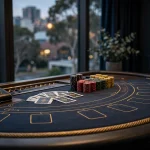
The table is part of the game’s identity. It gives the activity a shared focal point: players gather around a marked surface, while the dice are the obvious centre of attention. If you have only seen craps represented on screen, a physical table can seem like a lot to take in at once. There are markings, other players and a pace set by the group. The overall impression is lively. The markings are not decoration.
I would resist the temptation to treat a quick glance at the layout as a full explanation. A label, a betting area or a familiar-looking pair of dice may suggest what is happening, but it cannot substitute for understanding the version in front of you. Even the phrase “craps table” tells you the broad subject, not how every part of that particular game works. Names and presentation can be familiar while the practical details still need attention.
That is also why “real casino dice” can be a misleading point of focus. Whether you are looking at physical dice or a depiction of a dice table, the object alone does not explain the game. What matters is how the game defines its outcomes and how its instructions connect those outcomes to the table. The dice are visible; the meaning assigned to them is the part you need explained. A prop is not a rulebook.
Live Blackjack Online Casinos in Australia: Legal Context
If you are new to craps, start by observing rather than trying to follow every movement at once. Notice where attention is directed, how participants refer to the table, and whether the explanation you have been given matches what you see. If it does not, pause and ask for clarification before joining in. There is no prize for pretending the layout makes instant sense. It often doesn’t.
Craps also carries a strong table-game feel, but that atmosphere should not be confused with a promise about how play will unfold. A busy-looking table can make the game seem easier to understand than it is. I find it helps to separate the spectacle from the information: first identify that this is craps, then work out what the displayed areas and actions mean in that version. Keep those as separate steps.
So, when someone says “casino craps,” picture a dice-centred table game rather than a general category of dice entertainment. When they mention the table, take that as a clue to the setting, not a complete account of its operation. The useful question is not whether the dice look familiar, but whether you can explain what the table is asking you to understand. If you cannot yet, keep watching. That is a perfectly sensible place to start.
Rules and What to Check Before Choosing a Dice Game
A name tells you very little about how a dice game works. Before comparing options, read the rules for that specific game, not a summary of a similar one. Shared words such as “roll”, “pass” or “total” do not guarantee that two games treat an outcome in the same way.
Start with the objective. Find out what counts as a win, whether the result depends on a single roll or a sequence, and what happens if the result is a tie or neither side wins. Then check how a round begins and ends. The rules should make clear who acts, what triggers another roll, and when the game resets. If a step is unexplained, do not fill it in from memory of another dice game.
Next, look closely at every available wager. The rule sheet should say what result each one covers, when a bet is settled and what it pays. Check whether a wager remains active across later rolls or is decided immediately. A payout table is useful only when you understand the condition attached to each entry; a tempting label is not a substitute for the full rule.
Also look for restrictions that can change how a round is played: permitted bets, minimums or maximums, whether bets can be changed after a roll, and any special conditions. These details are game-specific. If the rules use terms you cannot define, or leave a dispute to a vague house decision, pause rather than guessing.
Before Choosing a Game
- Identify the objective and what counts as a win
- Verify if the result depends on one roll or a sequence
- Review the payout table for every available wager
- Check for minimum and maximum bet restrictions
- Confirm that the rules page matches the version being presented
When comparing games, use the same questions for each one: Is the objective clear? Can you trace every possible outcome to a stated result? Are the payouts and conditions explained together? Does the rules page match the version being presented? A game is not “best” simply because its rules look short or its name is familiar. Clarity matters more than a quick first impression.
I would keep the rules open while learning and check a disputed point before staking money. That is not a system for improving results; it is a way to avoid misunderstanding what you are agreeing to. Do not treat a rules summary as complete if it omits a payout condition or an exception.
Gambling is for people aged eighteen or older, and it should never be treated as income. Problem gambling can cause serious harm, particularly for vulnerable people. If the rules are unclear, leave the game alone. Simple enough.
A Sober Approach to Dice-Game Strategy
When people talk about strategy for a casino dice game, they can mean two different things: choosing between decisions the rules allow, or trying to predict what the dice will do. The first can be studied. The second is not something a betting pattern can control. A run of results does not make a particular roll due.
I start with the rules, then separate what I can decide from what I cannot. Depending on the game, choices may affect the risk attached to a wager; they do not guarantee a result. There is no universal approach that transfers neatly across every game using dice. If a claim depends on a particular bet or payout, check it against that game’s own rules rather than treating it as general casino dice strategy.
Pokie Machines in Australia: What to Know Before Playing
Before playing, set a firm spending limit and a time limit, and decide in advance what will make you stop. Keep the money for play separate from bills and other essentials. If you reach the limit, stop; don’t raise it to recover a loss. That is not a strategy. It is the moment the plan has gone.
It also helps to judge a decision by what you knew when you made it, not only by the result. A sensible choice can lose, and a poor one can win by chance. I find that distinction useful because a lucky outcome can make a risky decision look clever. It wasn’t.
Avoid systems that promise steady profits, guaranteed wins or a way to beat randomness. Betting more after losing does not make previous losses easier to recover, and a string of wins is no proof that the next result is predictable. If you cannot explain a proposed system without relying on certainty about future rolls, leave it alone.
For any dice game at a casino, strategy should mean understanding the choices, being honest about uncertainty and keeping play within limits—not finding a secret formula. You must be at least 18 to gamble. Gambling can cause serious harm, particularly for vulnerable people; if play is affecting your finances or wellbeing, step away and seek support.
What Live Dice Play Means
“Live” describes how a dice game is presented: a real person hosts a round in a studio or other set, while a camera feed shows the action to remote viewers. A screen interface may sit alongside the video, giving participants a way to follow the round and interact with the game. The label is about the presentation, not a separate kind of dice.
Real-Money Casino Table Games in Australia
That distinction matters. A live feed can make a game feel closer to watching a table than watching an animation, but the stream alone does not tell you how the rules work, how outcomes are settled or what conditions apply. Those details belong to the individual game. I would treat the video and the written rules as separate things to understand, not assume one explains the other.
The word “live” can also be used loosely in descriptions. It does not, by itself, establish that a game is fair, that a particular method is used to determine an outcome, or that a service is lawful for an Australian audience. Here, real-money online casino services are prohibited from being provided to people in Australia. That is the practical boundary, even where an overseas site is visible online.
If you are simply trying to understand the format, picture a host, a camera and a digital interface sharing the same round. The host provides the visible action; the interface presents whatever choices or information the game uses. Exactly what you see depends on the game.
Live presentation is not a reason to treat gambling as harmless entertainment. Gambling can cause serious harm, particularly for vulnerable people. You must be at least eighteen to gamble, and no live feed changes that. A camera makes the room feel closer. It does not change the risk.
Where You Roll: Dice Games at a Table or on a Screen
When you picture a casino game with dice, you might imagine a table, a pair of dice and a player sending them across a felt surface. That physical image is useful, but it is only one way dice can appear in a game. The setting changes what you see and interact with; it does not, by itself, tell you what the game’s rules are.
Video Slots in Australia: Mobile Play and Game Basics
At a physical table, the dice are objects in the room. You can see them being handled and rolled, and the table provides a shared space for the game. The experience is tactile and social in a way a screen cannot reproduce. I find that distinction easy to miss when a game is described simply as one where you throw dice.
On a screen, the roll is represented digitally. You may see dice rendered as images or an animation, rather than handling physical objects yourself. The visual presentation can suggest the familiar action of rolling, but it is still a screen-based format. Don’t assume that the animation tells you everything about how a game works; the game’s own instructions are what explain its controls and outcomes.
Those two settings can also shape how you follow what is happening. At a table, your attention is on the objects and activity in front of you. On a screen, it is on the display and the information the game presents. Neither setting is a shortcut to understanding the game. The same-looking dice can sit inside different game designs, so appearance alone is a poor guide.
I’d start by asking a simple question: are you looking for the physical feel of rolling dice, or a digital version of that action? That helps you identify the format without confusing it with a particular game or assuming that every screen-based version works alike. A roll is a format cue, not a rulebook.
Wild Fortune games, providers and live casino

Three-Reel Slots in Australia: Features and RTP
Understand how reel mechanics, bonus features, RTP, demo access and Australian rules shape what to...

Five-Reel Slots in Australia: What to Check
Reel count alone does not determine a game's rules or returns; RNG outcomes are independent,...

7-Reel Slots in Australia: Rules, Odds and Access
A practical look at reel counts, game versions, free-play limits, real-money checks and the odds...

Bonus Buy Slots in Australia: Features and RTP
Bonus buys provide direct entry to a feature, but outcomes remain random and the purchase...

High-Volatility Slots in Australia: How They Work
Volatility describes a broad balance between win frequency and potential size, not a schedule or...

Low-Volatility Slots in Australia: How They Play
Learn how volatility describes win frequency and payout swings, and why a steadier-looking session still...

Pokie Machines in Australia: What to Know Before Playing
A practical guide to game features, odds, free play, payments and the legal limits on...

Progressive Jackpot Slots: How They Work
See how progressive pools are funded and what game triggers, payout terms and bonus conditions...

Best RTP Slots in Australia: Understanding RTP
RTP can help compare long-run game expectations, but versions and short-term results mean the displayed...

Video Slots in Australia: Mobile Play and Game Basics
A practical guide to mobile slot interfaces, free-play modes, Australian access considerations and checking game...

Crash Casino Games in Australia: Rules and Risks
A practical overview of how Australian rules, verification, payment terms and game fairness claims shape...

Lightning Link Online Pokies in Australia: What to Know
The guide separates venue machines from online casino claims and explains the Australian rules for...

Live baccarat online in Australia: legal guide
Australia has no officially licensed online casinos, and live-dealer baccarat remains an online casino service...

Live Blackjack Online Casinos in Australia: Legal Context
Understand what live dealer play involves, how to assess a site, and which game, payment...

Live Roulette in Australia with English-Speaking Dealers
Australia’s restrictions on online casino services shape how live roulette, real-money play, dealer language and...

Mines Casino Game in Australia: What to Check
A Mines title’s rules, demo mode, bonus terms and cashout details need checking separately from...

Plinko Casino Australia: Games, Payments and Rules
Plinko titles can use reels, a dropping-ball board or a mix of both, so the...

Pokies Tips and Tricks: What Can They Change?
Understand how random spins shape pokies play, and why practical checks and session boundaries matter...

Real-Money Casino Table Games in Australia
A practical guide to the legal position, online play formats, odds, basic bets and the...